A Comprehensive Guide to Slope Stability: Methods and Applications
Slope stability plays a foundational role in the success, safety, and longevity of development projects. For developers, engineers, municipalities, and planners, it is critical to understand how and why slopes behave the way they do across environments. This is essential for avoiding structural failures and safety hazards from natural terrain to engineered environments.
When addressed early, slope stability analysis supports risk avoidance, design optimization, regulatory compliance, and resilience under changing environmental conditions.
Blog Overview
In this guide, we'll cover:
- What slope stability means in geotechnical terms
- Key causes of instability and failure
- Methods used to assess and stabilize slopes
- Real-world applications
Understanding Slope Stability
Slope stability refers to a slope’s ability to resist movement or failure over time. Landslides, slumping, and progressive erosion are common results of slope instability. While many failures are triggered by natural forces such as rainfall, earthquakes, or snowmelt, human activity often plays a role in accelerating or exacerbating underlying conditions.
Landslides cause an estimated $1–2 billion in damage annually in the United States and result in dozens of fatalities (5).
In geotechnical engineering practice, slope stability is typically evaluated using a factor of safety (FoS). The FoS is a ratio of resisting forces (such as soil cohesion and internal friction) to driving forces (like gravity, structural loads, or groundwater pressure). A FoS below 1.0 signals likely failure under current conditions, while values in the range of 1.3 to 1.5 are generally considered acceptable for long-term stability (4).
These thresholds are not universal, and they depend on factors such as material properties, slope geometry, intended land use, and the acceptable level of risk for the project.
Factors That Influence Slope Failure
Slopes are vulnerable to a mix of natural and man-made forces. The most common contributors include:
lude:
- Soil composition: Loose or unconsolidated soil typically exhibits lower shear strength and higher susceptibility to movement under load or during rainfall.
- Vegetation loss: Tree roots and dense ground cover help reinforce slope soils, while their removal weakens structural resistance.
- Groundwater flow: Elevated pore water pressure reduces internal friction and adds weight to the slope, potentially compromising overall stability.
- Excavation and loading: Roadway cuts, grading, and concentrated structural loading can increase stresses that initiate sliding or deformation.
Understanding these forces enables long-term planning and proactive risk mitigation. These factors rarely act in isolation. Slope failures often result from the interaction of multiple conditions. Among these, variability in soil strength and elevated pore water pressure are consistently identified as leading contributors to slope failure initiation (6).
Recognizing factors that influence slope failure and how they manifest at a specific site helps teams anticipate potential modes of failure and determine whether reinforcement, drainage improvements, or monitoring are required.
Methods for Slope Stability Analysis
To predict how a slope may behave under varying conditions, a combination of field investigations, laboratory testing, and engineering models is employed. Engineers typically rely on both static and dynamic analysis methods to assess failure risks and determine appropriate strategies for mitigation.
Static Analysis
Static analysis evaluates slope stability under typical, non-seismic conditions. The primary objective is to determine the FoS. To support these calculations, engineers often employ Cone Penetration Testing (CPT) to collect high-resolution subsurface data. CPT provides key parameters like tip resistance, sleeve friction, and pore water pressure. These metrics are essential for understanding subsurface strength and stratigraphy in slope stability modeling (3).
Dynamic Analysis
While static analysis addresses typical conditions, dynamic analysis evaluates how a slope responds to sudden or extreme loading events like seismic events. These forces can temporarily reduce soil shear strength and significantly alter slope behavior.
For projects requiring deeper insight (such as critical infrastructure or sites in high-seismic zones), time-history simulations use real or synthetic ground motion records to model slope response and deformation potential more accurately under earthquake conditions. This provides guidance beyond pseudo-static analysis that offers a conservative, simplified approach to screening for seismic vulnerability by applying an equivalent horizontal force to the slope (1).
Geophysical applications for slope stability analysis
Geophysics supports slope stability analysis by providing subsurface information to complement drilling with soil sampling and laboratory testing. Methods such as electrical resistivity, seismic surveys, and ground penetrating radar help identify stratigraphy, weak zones, groundwater conditions, and potential slip surfaces. This information is used to build a better subsurface model, reduce uncertainty in failure mechanisms, and improve the selection of critical slip surfaces and porous conditions.
Reinforcement & Remediation Techniques
When slope instability is detected, remediation strategies must be tailored to the site’s specific conditions, including soil properties and geometry, groundwater behavior, and adjacent infrastructure. The most effective approaches are those that reduce driving forces and increase resistance within the slope system.
Commonly used techniques include:
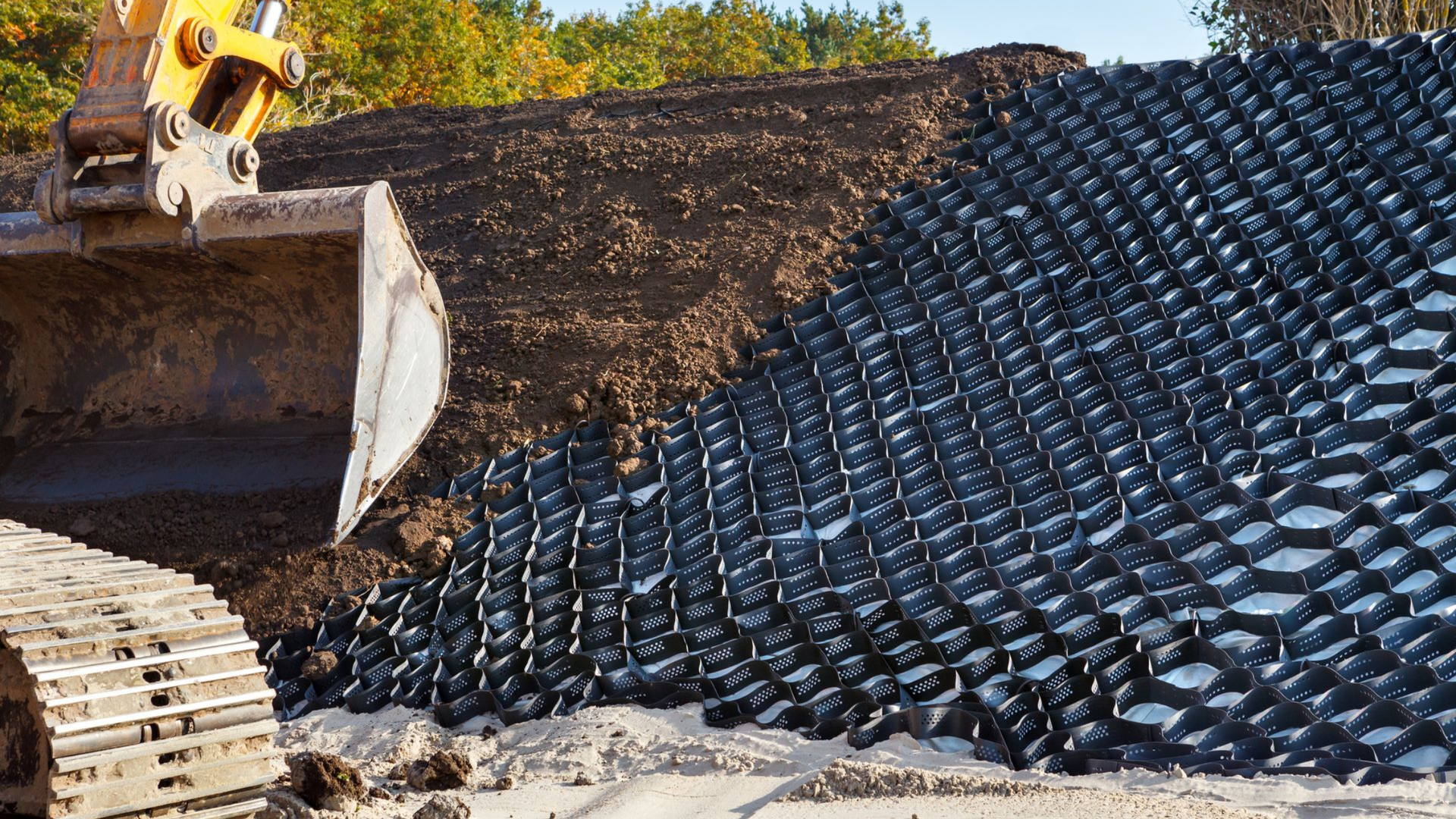
- Geotextiles and geogrids provide tensile reinforcement within soil layers, improving overall shear strength and controlling movement along potential failure planes.
- Retaining walls resist lateral earth pressures and are especially useful in built environments with limited space.
- Drainage systems, such as horizontal drains and surface channels, help control groundwater conditions and reduce pore water pressure, a leading contributor to slope failure.
- Soil nails and rock bolts reinforce slopes by securing weaker surface materials to stronger underlying layers, often paired with facing systems to improve surface stability (2).
- Grading and terracing reduce the slope angle and redistribute earth loads, often improving drainage patterns in the process.
These solutions are most effective when guided by predictive tools and design criteria that consider historical landslide data, site topography, and local precipitation trends (6). These recommendations help ensure remediation efforts align with best practices for both public safety and long-term infrastructure performance.
Real-World Applications & Considerations
Slope stability is crucial to the success and safety of residential, commercial, and infrastructure projects across the country. Developments, including hillside subdivisions, riverbank walkways, utility corridors, and highway embankments, are all vulnerable to slope movement if not properly assessed during the planning and construction phases.
In many cases, early warning signs can be observed on-site. Tilted trees, cracked pavements, bulging retaining walls, and saturated ground are often indicators of gradual slope deformation. With this identification, engineers and project managers can initiate corrective actions to prevent conditions from escalating into full slope failure (5).
Incorporating slope stability analysis into early project phases offers significant benefits:
- Long-term durability: Engineered slopes are more resistant to erosion, sliding, and settlement over time.
- Regulatory compliance: Projects adhere to federal and local slope design standards, reducing delays and liability.
- Public safety: A well-stabilized slope lowers the risk of injury, property loss, and environmental impact.
- Cost control: Proactive assessments help identify problem areas before they require considerable structural remediation.
Additionally, modern hazard mapping tools that incorporate historical landslide data, terrain analysis, and rainfall patterns can be used to pre-screen locations for geotechnical concerns during site selection. Key decision-makers can understand where the greatest risks are, helping guide how to lower given risks or design appropriately for those with known instability (5).
Understanding slope behavior isn’t just about compliance, but about building smarter, safer, and more sustainable.
How APEC Supports Slope Stability in Projects
Our geotechnical team partners with clients to assess slope risks and tailor stabilization strategies to meet the unique demands of each site.
Whether you’re developing along a hillside, improving infrastructure, or planning new construction, we apply proven methods to help move projects forward with a strong, reliable foundation.
Learn more about our slope stability services →
References
- Duong, T. V., Yin, Z.-Y., & Sheng, D. (2023). Time-history dynamic analysis of slope stability using elastoplastic stress–strain models. Engineering Geology, 322, 107013. https://doi.org/10.1016/j.enggeo.2023.107013
- Federal Emergency Management Agency. (2022). Earth slope stabilization (Fact Sheet 5.3, FEMA P-2181). U.S. Department of Homeland Security. https://www.fema.gov/sites/default/files/documents/fema_earth-slope-stabilization_fema-p-2181.pdf
- ScienceDirect. (n.d.). Cone penetration test. In Earth and Planetary Sciences Topics. Retrieved October 25, 2025, from https://www.sciencedirect.com/topics/earth-and-planetary-sciences/cone-penetration-test
- Tripathy, S., & Singh, V. (2025). Reassessing slope stability: Practical limits of the factor of safety in modern geotechnical design. Case Studies in Infrastructure Engineering, 2, 100011. https://doi.org/10.1016/j.csie.2025.100011
- U.S. Geological Survey. (2022). National strategy for landslide loss reduction. https://pubs.usgs.gov/of/2022/1075/ofr20221075.pdf
- Zhang, Y., Liu, B., Li, S., & Wang, H. (2024). Assessment of slope instability: Machine learning approaches versus conventional methods. Scientific Reports, 14, Article 90882. https://doi.org/10.1038/s41598-024-90882-1